


Page 8 - Practical Petroleum Geology, 2nd Edition
P. 8
Petroleum Extension-The University of Texas at Austin


                   ny examination of the subject of petroleum geology must first begin with a   Introduction
               Abrief consideration of where the petroleum came from in the first place.
                    The popular organic theory states that the hydrogen and carbon that
               make up petroleum come from the remains of microscopic organisms that
               lived in the rivers and seas covering the Earth’s surface millions of years
               ago. As these organisms died, they fell to the ocean floor and mixed with
               silt, sand, and mud. Eventually, a thick body of sediments enriched by the
               organic remains accumulated on the bottom of the ocean.
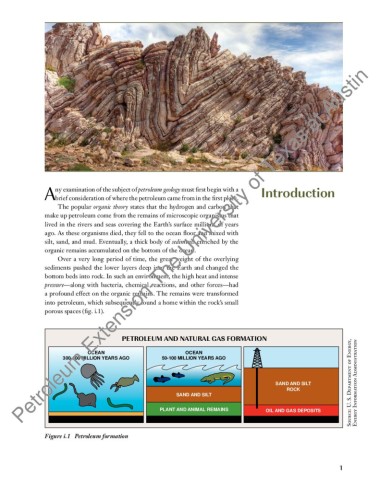
                    Over a very long period of time, the great weight of the overlying
               sediments pushed the lower layers deep into the Earth and changed the
               bottom beds into rock. In such an environment, the high heat and intense
               pressure—along with bacteria, chemical reactions, and other forces—had
               a profound effect on the organic remains. The remains were transformed
               into petroleum, which subsequently found a home within the rock’s small
               porous spaces (fig. i.1).


                                        PETROLEUM AND NATURAL GAS FORMATION
                                                                                                                  Source: U. S. Department of Energy,  Energy Information Administration
                             OCEAN                           OCEAN
                     300-400 MILLION YEARS AGO       50-100 MILLION YEARS AGO


                                                                                          SAND AND SILT
                                                                                             ROCK
                                                          SAND AND SILT

                                                    PLANT AND ANIMAL REMAINS           OIL AND GAS DEPOSITS


               Figure i.1   Petroleum formation


                                                                                                              1

