


Page 9 - Practical Petroleum Geology, 2nd Edition
P. 9
Introduction                                                       PRACTICAL PETROLEUM GEOLOGY


                                                   One common misconception about the nature of petroleum is that
                                               it exists in large underground formations that are similar to flowing rivers
        Petroleum Extension-The University of Texas at Austin
                                               and lakes. Instead, most petroleum is found within rocks. Some rocks have
                                  PORE
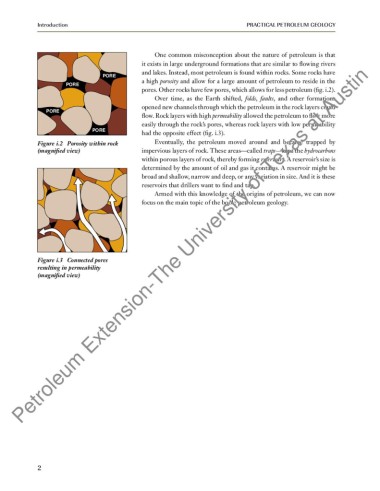
                      PORE                     a high porosity and allow for a large amount of petroleum to reside in the
                                               pores. Other rocks have few pores, which allows for less petroleum (fig. i.2).
                                                   Over time, as the Earth shifted,  folds,  faults, and other formations
                                               opened new channels through which the petroleum in the rock layers could
                PORE
                                               flow. Rock layers with high permeability allowed the petroleum to flow more
                                               easily through the rock’s pores, whereas rock layers with low permeability
                               PORE
                                               had the opposite effect (fig. i.3).
             Figure i.2   Porosity within rock     Eventually, the petroleum moved around and became trapped by
             (magnified view)                  impervious layers of rock. These areas—called traps—kept the hydrocarbons
                                               within porous layers of rock, thereby forming reservoirs. A reservoir’s size is
                                               determined by the amount of oil and gas it contains. A reservoir might be
                                               broad and shallow, narrow and deep, or any variation in size. And it is these
                                               reservoirs that drillers want to find and tap.
                                                   Armed with this knowledge of the origins of petroleum, we can now
                                               focus on the main topic of the book: petroleum geology.


             Figure i.3   Connected pores
             resulting in permeability
             (magnified view)


             2

